Prompt-to-app builder
Write a paragraph about the process you want to digitise. LX CMD generates the schema, CRUD screens, validation rules and role-based access — then hands you the editor to refine it.
LX CMD turns plain-language requirements into working internal apps, customer portals and system integrations. Your team designs on a visual canvas, our AI writes the data model, screens and logic — and you keep every escape hatch to real code.
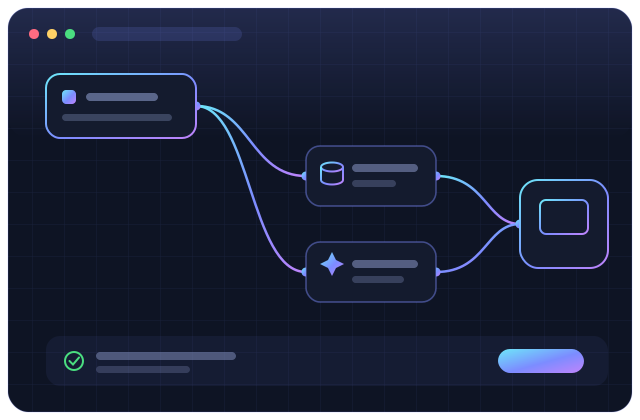
Most teams stitch together a form builder, an automation tool and a middleware layer — then maintain all three. LX CMD collapses them into a single environment with one permission model, one deployment pipeline and one audit trail.
Write a paragraph about the process you want to digitise. LX CMD generates the schema, CRUD screens, validation rules and role-based access — then hands you the editor to refine it.
Drag nodes to build logic: branching, loops, approvals, scheduled jobs, retries with backoff and dead-letter handling. Every run is traceable step by step.
Native connectors for ERP, CRM, ticketing, payments and warehouses — plus generic REST, GraphQL, SOAP, SQL, SFTP and webhook blocks for everything else.
Point an agent at your documents and databases, give it tools from your connector library, and publish it as a copilot inside any app you build — with grounded answers and citations.
Drop into TypeScript or Python whenever the visual layer runs out. Version everything in Git, run your own npm and PyPI packages, and unit-test flows in CI.
SSO and SCIM, granular RBAC, secret vaults, dev/staging/prod promotion, immutable audit logs and data-residency options for EU, US and on-prem deployments.
No procurement cycle, no six-month discovery phase. Your first working prototype lands in the same meeting you described it.
Type the requirement in your own words — “a portal where suppliers upload invoices, finance approves them, and approved ones post to our ERP.” LX CMD proposes the data model and screens.
Authenticate once per system. Fields are mapped automatically, schemas are introspected, and drift is flagged before it breaks a live flow.
Adjust layouts, add business rules, set permissions per role, and write code where it matters. Preview against real sandbox data at every change.
Promote to production in one click, on our cloud or in your own VPC. Track runs, latency, failures and cost per workflow from a single dashboard.
Bi-directional sync, event streaming or scheduled batch — per connection. Build a missing connector once and reuse it across every app in your workspace.
Every one of these started as a spreadsheet, an inbox rule or a request that sat in the IT backlog for a quarter.
Order tracking, inventory reconciliation, field-service scheduling — with real permissions and an audit trail instead of a shared file.
Branded self-service for quotes, tickets, documents and payments, reading live from the systems that already own the data.
Multi-step approvals with SLA timers, escalation paths and automatic posting to your ERP once a threshold is met.
Keep customers, products and invoices consistent across CRM, ERP and warehouse — with conflict rules you can actually read.
Extract structured fields from invoices, contracts and forms, route exceptions to a human, and answer staff questions from internal policy docs.
Wrap an old system in a modern UI and API without a rewrite, then migrate module by module on your own timeline.
Unlimited end users on every plan. You pay for the people who build, not the people who use what they built.
For a first prototype or a single team workflow.
For departments shipping several apps a quarter.
For regulated environments and platform teams.
Tell us about the process you want to automate. Fill in the form and we'll take it from there — no phone tag, no sales sequence.
Monday–Friday, 09:00–18:00
Bring one stalled request to a 30-minute call. We'll build a working version of it live.